GUIDE
Sintered stone vs quartz vs granite
All three make a good kitchen top when fabricated and installed well. They differ in how they are made, how they handle heat and how forgiving they are at the edges.
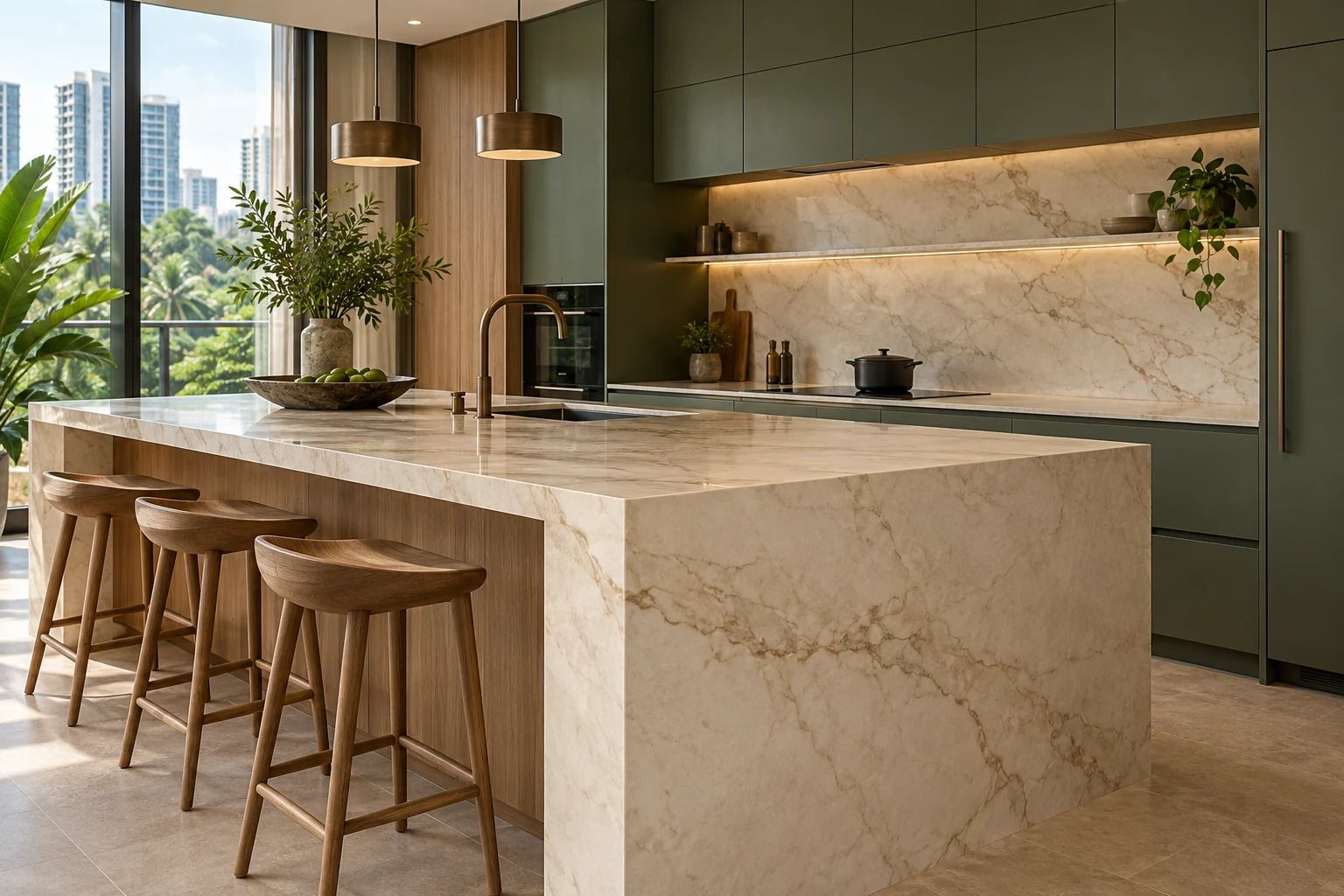
At a glance
| Sintered stone | Engineered quartz | Natural granite | |
|---|---|---|---|
| Made from | Natural minerals pressed and fired, without resin | Crushed quartz bound with resin | Quarried natural stone |
| Heat | High tolerance. Follow the maker’s guidance on hot cookware | Resin can mark or discolour under hot pots. Use a trivet | Good tolerance. Sudden heat can still stress the stone |
| Stains | Very low porosity. No sealing needed | Low porosity. No sealing needed | Porous to varying degrees. Usually sealed |
| Edges | Hard and thin edges can chip on impact | Slightly more forgiving | Varies by stone |
| Pattern | Often printed on the surface. Some ranges carry it through the body | Consistent through the slab | Unique to each slab |
| Fabrication | Needs suitable tools and experience | Widely fabricated | Widely fabricated |
When sintered stone makes sense
Choose it if you want a slim profile, a matt stone or concrete look, or the same surface on the counter, backsplash and wall. It suits cooks who move hot pans around and homes with strong sunlight near the kitchen.
The trade-off is at the edges and cutouts. The material is hard, so a sharp knock on an exposed edge can chip it. Good fabrication and support matter more than with quartz.
When quartz makes sense
Quartz is familiar to most fabricators and comes in many consistent patterns. It is a practical choice when you want a thicker, solid look and a predictable result. Keep hot cookware off the surface.
When granite makes sense
Granite suits people who want real stone with natural variation. View and reserve the actual slab, and ask how often it should be sealed.
Questions that settle it
- How do you cook? Frequent high-heat cooking favours sintered stone or granite.
- Do you want a thin edge or a chunky one?
- Will the top sit near a window with strong afternoon sun?
- Is your fabricator experienced with the material you prefer?
COMMON QUESTIONS
Quick answers
Is sintered stone better than quartz?
Neither is better for every home. Sintered stone generally tolerates heat and sunlight better. Quartz is usually more forgiving at the edges and is familiar to more fabricators. Compare the data sheets and your fabricator’s experience.
Is sintered stone the same as porcelain?
They are closely related. Both are mineral mixes pressed and fired at high temperature. Manufacturers use different names and processes, so compare the technical data for the exact product.
Does sintered stone need sealing?
Most sintered stone has very low porosity and does not need sealing. Follow the care guide from the manufacturer of your slab.