GUIDE
Single profile, double profile and other sintered stone edges
The edge decides how thick your top looks, how much fabrication it needs and how well it copes with daily knocks. Ask for it as its own line in every quote.
Edge types at a glance
Single profile
The edge shows the slab’s own thickness for a slim, modern line.
- Good for
- Usually the simplest edge to fabricate.
- Check
- A slim slab depends on firm, level support beneath it.
Double profile
A strip of the same stone is joined under the front edge, so the top looks about twice as thick.
- Good for
- A heavier look. It can also hide the plain core of slabs whose pattern is only on the surface.
- Check
- More fabrication work. Check the joint line and how the pattern meets.
Mitred apron
A deeper front strip is joined at 45 degrees, so the pattern wraps over the edge.
- Good for
- Reads as a solid, thick block of stone.
- Check
- Sintered stone is demanding to mitre. Ask to see a finished sample.
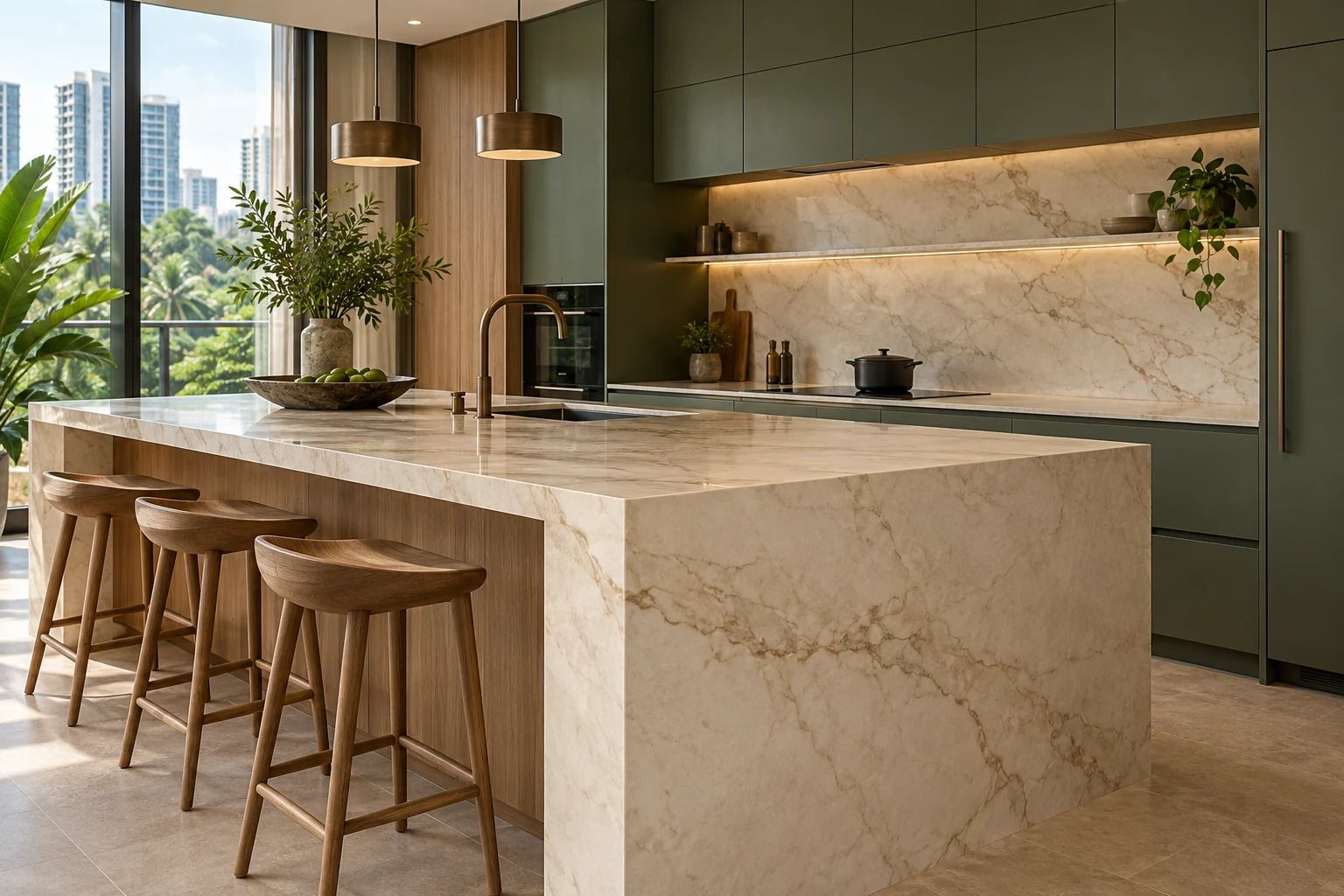
Waterfall
The stone turns down the end of an island or counter to the floor.
- Good for
- A strong feature on an island.
- Check
- Measured as extra height. Plan the joint and pattern flow in advance.
Edge shape
Square
Crisp, but the sharp corner chips most easily.
Eased
Square with a lightly softened corner. A practical everyday choice.
Bevel
A small angled cut that spreads knocks better.
Half bullnose
Rounded top corner. Grinding can expose the core on some slabs, so check first.
Shark nose
Slopes back underneath for a floating look. Check how it is supported.
Side views, not to scale. Edge availability depends on the slab and the fabricator. Decorative profiles such as ogee are rarely offered for sintered stone.
Single or double profile?
Choose single profile for a slim, minimalist kitchen and the simplest fabrication. Choose double profile when you want a heavier edge, or when the slab’s pattern is printed on the surface and the plain core would otherwise show at the edge.
Both are common in Singapore. The price difference depends on the fabricator, so compare quotes with the same edge.
When to consider a mitred apron or waterfall
A mitred apron wraps the pattern over a deeper front edge. A waterfall carries the stone down the end of an island to the floor. Both are striking and both take precise cutting, which sintered stone makes demanding. Ask to see finished work by the same fabricator.
Ask before you confirm
- Which edge type and shape is included in the price?
- How thick will the finished edge look?
- Where will the joint line sit, and how will the pattern meet?
- Can I see a finished sample of this edge on this slab?
COMMON QUESTIONS
Quick answers
What is the difference between single profile and double profile?
A single profile edge shows only the slab’s own thickness. A double profile edge has a second strip of stone joined under the front edge, so the top looks about twice as thick. Fabricators usually price the edge separately, so ask for it as its own line in the quote.
Which edge is least likely to chip?
A softened edge such as eased or bevelled spreads impact better than a sharp square corner. Good support and careful fabrication matter as much as the shape.
Is a double profile stronger?
It makes the front edge look thicker and adds material where knocks happen, but strength still depends on support underneath and the quality of the joint. Ask the fabricator how the strip is bonded.