GUIDE
Sintered stone thickness and edge profiles
Thickness and edge profile decide how the top looks from the side, how it must be supported and how well the edge survives daily knocks.
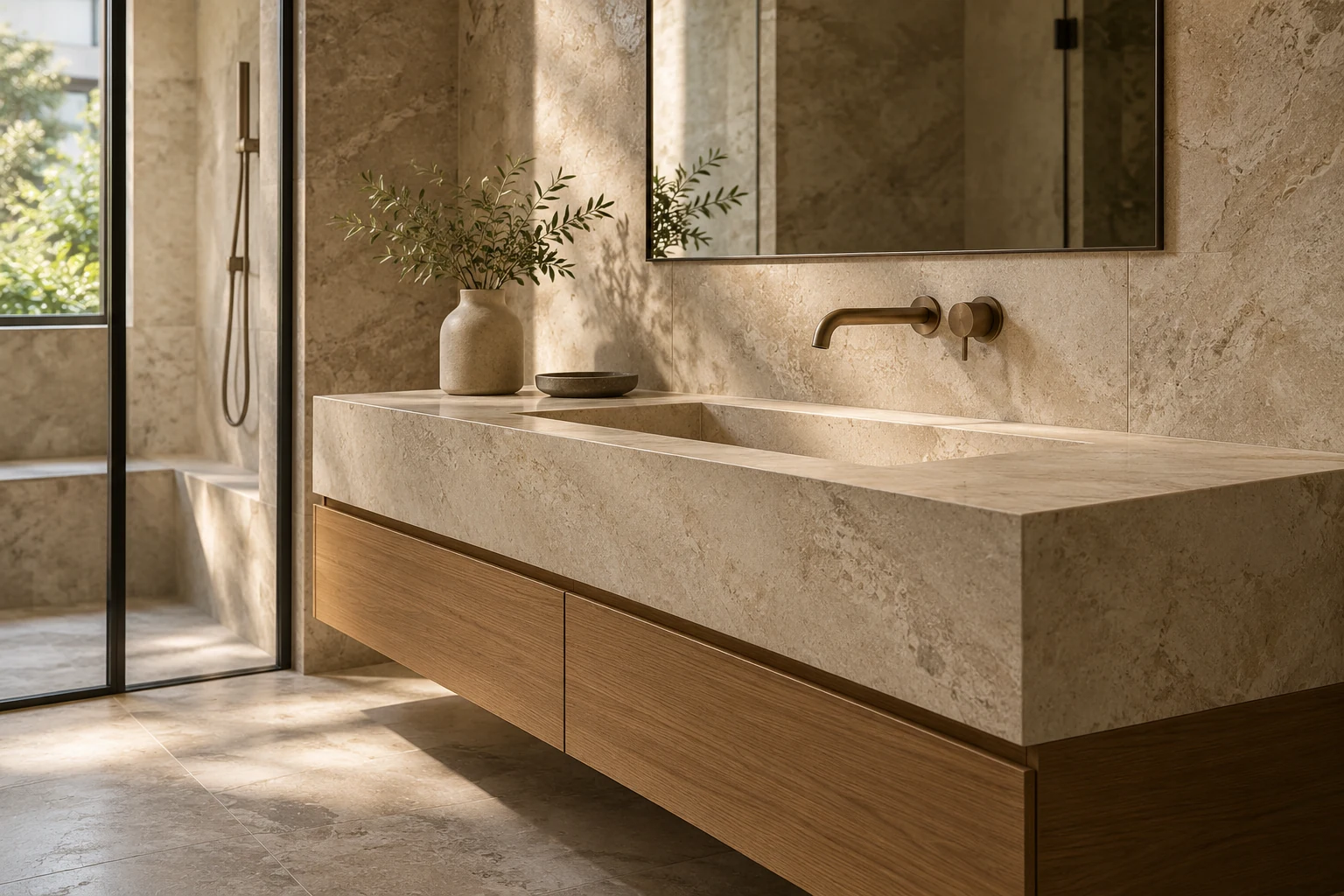
Slab thickness
Brands offer sintered stone in several thicknesses, from thin sheets for walls and cabinet fronts to thicker slabs for worktops. The available options differ by brand and colour, so check the catalogue for the surface you like.
Thinner slabs give a slim, modern line but depend on firm, level support beneath them. Thicker slabs are more forgiving and can span small gaps. Ask which thickness the manufacturer recommends for worktops with your cutouts.
Common edge profiles
- Eased or slightly rounded edge. Simple, practical and the least likely to chip.
- Bevelled edge. A small angled face that softens the corner.
- Mitred apron. Two pieces joined at 45 degrees so that a thin slab looks thick. It needs precise cutting and pattern matching.
- Shark nose or undercut. The edge slopes back underneath for a floating look. Check how it is supported.
Matching the pattern
Where the pattern sits on the surface, the core of the slab can show a plain colour at the edge. A mitred edge hides this. For a veined design, ask how the veins will line up at the mitre and at any joints.
Vanity tops and walls
Vanity tops are short, so a thin slab on a solid cabinet works well. For an integrated stone basin, ask how the joints are sealed. For walls, thin large-format sheets reduce weight and grout lines; the installer should confirm the wall is flat and suitable.
Ask before you confirm
- Which thickness do you recommend for my layout, and why?
- How will the top be supported around the sink and hob?
- Where will the joints fall?
- Can I see a sample of the finished edge?
COMMON QUESTIONS
Quick answers
Is a thicker slab always stronger?
A thicker slab is more forgiving, but support and cutting quality matter as much. A thin slab on a flat, fully supported base can perform well when installed to the manufacturer’s guidelines.
Which edge profile chips least?
A slightly rounded or bevelled edge spreads an impact better than a sharp square edge.
What is a mitred apron edge?
A strip of the same slab joined to the front edge at 45 degrees. It makes the top look thicker and continues the pattern down the face.